Podcast Episode 3 – Creating Abundance to Decrease Competition with Trae Stephens of Founders Fund

subscribe to the podcast here

Today’s episode takes us to Silicon Valley connecting with Trae Stephens. You may have seen Trae on CNBC, or you may know him as one of the Partners at Founders Fund. It was an honor to have Trae on to share about his experiences—everything from his time in politics working for Congressmen and in Embassies to now working alongside Peter Thiel. Trae also shares about his life as a Christ Follower and how it shapes his view of the investing world.

In particular, Trae outlines what it means for an entrepreneur to be an outlier. He describes the difference between business ideas that fit into a certain pre-existing category and those that break every mold out there. He also shares cautionary advice about what not to do as an entrepreneur. His perspective as a venture capitalist is helpful to listen to for both investors and entrepreneurs alike.

But this podcast doesn’t stop there. As you know, we’re always approaching the conversation of entrepreneurship and investing from a faith-driven perspective. Trae is no exception. In this podcast, he talks about the different areas of theology and philosophy that inform his worldview. Specifically, he goes into detail about the innate tendency of all human beings to imitate something or someone. Here, he reminds us specifically of Ephesians 5:1, “Be imitators of God…”

When Trae talks about his relationship with God, you’ll hear both his personal faith journey—what it means to imitate Christ as a venture capitalist and how Silicon Valley opens the door for him to share his faith—and what he thinks about the global Christian movement. He invites listeners to consider what it would look like to be co-creators alongside God, with references to how God and Adam interacted in the Garden of Eden.

Our team had a blast catching up with Trae, as it felt like he covered dozens of topics with the fluency of an expert. His intellect and skill are on full display in this interview, but so is his spirit and heart behind what it means to be a faith driven entrepreneur and what faith driven investors can do to create value, not only for themselves, but for the world.

We hope you enjoy this episode and pray that it encourages you on your journey!

Useful Links:

Rene Girard Explains Mimetic Desires

Founders Fund

Trae Stephens Interview with Fortune

God’s Word and Prayer as a Handbook for Investing

  Image by    Patrick Fore

Image by Patrick Fore

With the help of faith friends from our gathering of Faith Driven Investors, we’ve begun drafting a set of Unifying Principles. Our hope is that we can begin to come together under these thoughts and ideas to work toward a more full vision of what it means to let our faith drive our investments.

If you have thoughts, questions, concerns, things you’d change or add, please let us know! We’re relying on you, our community, to make this resource the best it can be.

We believe that God speaks to us through His word and that all of Scripture is useful for instruction on how to formulate and execute an investment strategy. This includes our motive for investing well, the importance of saving, and how we might invest. Scripture, when taken in aggregate, provides us with a great handbook on every question of investing—why, how, where, what, and when.

Of course, Scripture is much more than simply a guidebook for investing—it is, after all, the written Word of God that contains everything we need to know and love Him. But within the pages of this book is a description of a way of life, a calling that is to something greater than earthly returns.

With that in mind, we turn the pages searching for God to reveal Himself in ways we may not anticipate. And as we do, we see countless passages that cover the topic of money—whether that be in terms of spending, saving, or investing. And we believe that these sections provide the key to investing from a faith-driven perspective. As in all things, God cares about who we are and what we do. Our investment strategy is no exception.

In addition to communicating with God through His Word, we also believe in the power of prayer. As followers of Christ, we have the ability to speak directly to our Creator and Savior about anything and everything. When it comes to our work, our families, and our lives, we are constantly seeking to consult God—to speak to Him about what we are doing and thinking and to ask for His input on all of it.

Bible reading and prayer are two of the key spiritual disciplines, and for the Faith Driven Investor, they are an absolute necessity.

Using Scripture as Our Guide

  • 2 Timothy 3:16-17 All Scripture is God-breathed and is useful for teaching, rebuking, correcting and training in righteousness, so that the servant of God may be thoroughly equipped for every good work.

  • Psalm 119:105 Your word is a lamp for my feet, a light on my path.

  • Proverbs 30:5 Every word of God is tested; He is a shield to those who take refuge in Him.

  • Matthew 7:24 Therefore everyone who hears these words of mine and puts them into practice is like a wise man who built his house on the rock.

  • Psalm 119:160 The sum of Your word is truth, And every one of Your righteous ordinances is everlasting.

  • 1 John 5:14 This is the confidence we have in approaching God: that if we ask anything according to his will, he hears us.

  • 1 Chronicles 16:11 Look to the Lord and his strength; seek his face always.

  • Philippians 4:6 Do not be anxious about anything, but in every situation, by prayer and petition, with thanksgiving, present your requests to God.

Real Estate + Impact Investing

  Image by    Chuttersnap

Image by Chuttersnap

Vip Vipperman was one of the presenters at our recent event for Faith Driven Investors, and he was kind enough to write down some of the insight he shared about the real estate market and what it might look like for investors seeking to increase their impact.

by Vip Vipperman

Any conversation about real estate investment comes down to two words: risk and reward. All investments have both, but let’s talk about some rewards that go beyond just financial to an even more significant impact for the Kingdom of God.

Real estate is a people business.

There is a chance to impact people for the Kingdom in every area of real estate, whether vendors, employees, tenants/residents, investors or brokers, as long as there is intentionality. We work with these people each day, but as Christ taught in the story of the Good Samaritan (Luke 10:25-37), we must truly see them, actually care about them, and then take compassionate action with the people we interact with on a daily basis. We can do this and make money at the same time.

Real estate investing can also be impact investing.

It is not a question of why we should consider the impact when making real estate investment, but why not? Everyone wants to invest with at or above market returns. This is wise and what we should do. But many might not know that there are many opportunities for good investments that also provide an opportunity to have an incredible impact for the Kingdom in addition to healthy market returns. What faithful believer with investment dollars ready to be put to work would not choose to invest this way if they knew the opportunity existed? We simply have to get the message out there to more listening ears.

Key focus areas to consider:

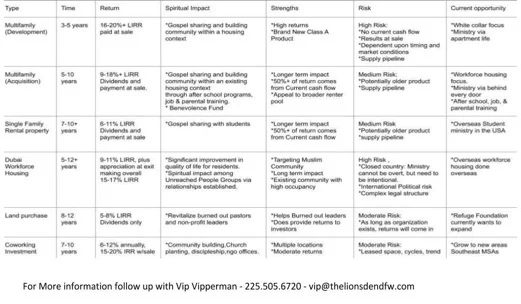
When looking at real estate impact investment opportunities, there are six key focus areas to consider: time, proforma returns, spiritual impact, strengths, risk and current opportunity. To give you an idea of what these opportunities look like, let’s look at the real opportunities listed below, which are all available today.

Questions to ask if considering a real estate impact investment:

Are you short term focused or long term focused?

Do you want mailbox money, smaller returns each month as dividends, or are you wanting a more substantial return and willing to wait a few years for it?

What type of spiritual impact is important to you? Do you want the gospel shared with the lost in your city, across the US, or in foreign lands among unreached people groups led astray by false religion? Do you want to help churches get started or pastors get refreshed?

How risk averse are you? Are you willing to trust a company with your money for a few years if it means more significant returns, or do you have to get a check in the mail each month and be able to drive by and see the project any time you want?

You should also begin to consider tax implications, leverage through debt and what to do with your returns in the form of charity for even more impact.

The opportunities are out there. We just have to take them.

Five Questions: Robert Kim

This video was originally published here.

Check out Access Ventures for other quality content!

At Access Ventures, they talk a lot about one-pocket investing and what it means for their organization.

And as they say themselves, we can’t do it all—no one can. Access Ventures partners with the Caprock Group as financial advocates for their values within the broader asset management system. Caprock provides investment options they wouldn’t otherwise find, backed by a rigorous diligence process on both financial and impact performance.

In this Five Questions video they talked with Robert Kim, client advisor at Caprock, about a one-pocket mindset and impact investing.  Watch the video below to learn more about how Robert and his team are rethinking asset management.

A Biblical Perspective on Investing and Economics

  Image by    TIU

Image by TIU

Tom Nelson was one of the presenters at our recent event for Faith Driven Investors, and he was kind enough to write down some of the insight he shared on the Biblical Perspective on Investing and Economics. Below is a transcript of his presentation

by Tom Nelson

Can we be faithful without being fruitful? It is a crucial question for each one of us to ponder. When Jesus gathered his apprentices around him in the upper room the night before his crucifixion, he said something of great importance.

In John’s Gospel, chapter 15:8 we read, “By this is my Father glorified, that you bear much fruit and so prove to be my disciples.” Jesus words must have riveted the disciple’s attention. Without hesitation, Jesus connects the Father being glorified and the ultimate authenticating mark of discipleship to Much Fruitfulness!

When Jesus said these words, what did he have in mind? The immediate context points to the fruitfulness of “abiding” which is relational intimacy with Himself. Those who abide in Jesus bear much fruit for Jesus. Yet what I think we often miss in this important matter of fruitfulness is Jesus had more in mind than merely intimacy with Himself or a growing Christlikeness of life manifested in the fruit of the Holy Spirit as important as that is!

A broader look at the Holy Scriptures from Genesis to Revelation as well as Jesus’ own teaching–reveals that the fruitfulness of our work is a vital aspect of Christian faithfulness.

In the book of Genesis we encounter a working God who created us with fruitfulness in mind. In Gen 1:28, we read, God blessed them and said, Be fruitful, and multiply and fill the earth and subdue it and have dominion. The Hebrew word translated fruitfulness here has two meanings. Procreativity and Productivity. Babies and work! Family and the job! Fruitfulness is often described in the OT as Fruit of the womb (babies) and fruit of the land (work).

In Proverbs 31…the personification of a wise life is depicted as a fruitful life—Prov. 31:31, speaks not of a king or a priest, but of a businesswoman. “Give her the fruit of her hands and let her works praise her in the gates.” And we must not forget that the entire Psalms are framed around Psalm 1 centered in the metaphor of a tree in season bursting with fruit.

We may overlook that Jesus spent the vast majority of his earthly life not as an itinerant Rabbi, proclaiming the kingdom of God, but as a worker making things and running a small business. Jesus was not only a brilliant teacher; He was also a skilled worker as well as a brilliant economist. It is not incidental that the vast majority of Jesus’ parables recorded for us in canonical Scripture were centered in the workplace and economic life.

While the bible speaks a great deal about our work and economic wisdom perhaps the most important parable for our specific purposes today is Jesus parable of the talents, recorded in Matthew 25. Let’s remember the context of this parable is Jesus speaking about the future, that day when the kingdom of God will be fully inaugurated in the New Heaven and New Earth.

Jesus tells the story of three first century investment portfolio managers and makes the point that the quality of the work we do now will have implications for the future. The portfolio managers entrusted with investment dollars for the purpose of further wealth creation and they are rewarded with that clear ROI objective in mind. One portfolio manager does not invest it, and has a zero ROI. For his lack of fruitfulness, his investment return, he is severely rebuked. The other two portfolio mangers invest wisely and they are commended for their ROI. We hear and long to hear in our own lives, Jesus words, “Well done good and faithful servant, you have been faithful over a little, I will set you over much. Enter into the joy of your master.”

Yet we must grasp Jesus commendation of faithfulness is not merely around sincere effort, but rather proportional fruitful outcome. For Jesus, faithfulness is clearly tied to fruitfulness—and here in our parable the focus is the fruitfulness of vocational productivity. Which in this case is the wise and fruitful investment of the owner’s money return. No wonder the Apostle Paul will urge Gospel transformed apprentices of Jesus to do their work heartily as for the Lord, and not for men. Why? Because the fruitfulness of our work will be one day rewarded by Christ.

As a pastor, let me say thank you for the work you do. The vocational calling of wealth creation, management and wise philanthropy is a high calling. The fruitfulness of your work matters to God and it matters to a needy world intricately interconnected in a global economy. As Jesus reminds us in the parable of the rich fool in Luke 12, this calling, like all callings is not for the purpose of self-indulgence or personal adulation, but for cultivating blessing out of the created order, for planetary sustainability, for redemptive capacity building, for the love of neighbor and the joyful stewardship of wise generosity.

Like the portfolio managers in Jesus’ parable, each one of us will be held to an account for the stewardship of our vocational productivity. Let me ask you: If Jesus were to give you your next job review what would he say? How would he rate your investment performance? Your philanthropic efforts? And of course at the end of the day, it is Jesus who will give each of us that final job review. And like the three portfolio managers, the fruitfulness of our lives including the fruitfulness of our vocations will be evaluated.

My wife’s dear friend Katherine Goldsmith lived in Kansas City all her life. She worked hard in a professional career, lived simply and invested wisely. Although Katherine never married, she had a heart for the educational challenges of single-parent families in our city. In her upper 80’s Katherine Goldsmith’s died, but she left behind a legacy of fruitfulness. Today my wife Liz sits on the board of the foundation that carries her name. A foundation that is devoted to help children of under resourced single-parent families’ flourish, by providing them the opportunity for an excellent private education.

So can we be faithful without being fruitful? To be faithful, we must be fruitful. Jesus actually raised the bar and said, very fruitful. By this is my father glorified that you bear much fruit and so prove to be my disciples. So let us embrace our callings with wholehearted commitment. Let us invest prayerfully! Diligently! Wisely! For the glory of God and love of neighbor, may our every good endeavor bear much fruit!

Stewardship vs. Ownership

  Image by    Lina Trochez

Image by Lina Trochez

With the help of faith friends from our gathering of Faith Driven Investors, we’ve begun drafting a set of Unifying Principles. Our hope is that we can begin to come together under these thoughts and ideas to work toward a more full vision of what it means to let our faith drive our investments.

If you have thoughts, questions, concerns, things you’d change or add, please let us know! We’re relying on you, our community, to make this resource the best it can be.

Adam didn’t create the Garden—he cultivated it. So, what has God put under your care? 

We believe that God owns it all—our finances, our influence, our everything. We will be held accountable for our faithfulness in stewarding His resources. Time, talent, treasure, truth, and relationships are gifts to be stewarded for the ultimate glory of the One who gave them. These resources are our one “minas,” as the Gospel of Luke describes—the one life we have been given. How we live it is up to us.

This life is a resource and we are responsible to do something with it. This results in an eagerness and excitement to work hard, invest well, and serve effectively as the vehicle through which God’s grace and love move. Every penny is an opportunity for God to work redemptively in the lives affected by every investment. As we steward what we have been given, we are free to experience the fullness of God’s joy.

Since God is the owner, we might also view him as the CIO of the investment world. As His portfolio managers, we should regularly seek Him through prayer, fasting, repentance, and expert counsel from people who share our faith regarding how we should allocate His resources. This approach to life comes with an eternal focus that always works with God’s return in mind

Using Scripture as Our Guide

  • 1 Peter 4:10 Each of you should use whatever gift you have received to serve others, as faithful stewards of God’s grace in its various forms. 

  • 1 Chronicles 29:11 Yours, Lord, is the greatness and the power and the glory and the majesty and the splendor, for everything in heaven and earth is yours. Yours, Lord, is the kingdom; you are exalted as head over all.

  • Matthew 25:20-21 The one who had received the five talents came up and brought five more talents, saying, ‘Master, you entrusted five talents to me. See, I have gained five more talents.’ His master said to him, ‘Well done, good and faithful slave You were faithful with a few things, I will put you in charge of many things; enter into the joy of your master.

  • Deuteronomy 10:14 Behold, to the LORD your God belong heaven and the highest heavens, the earth and all that is in it.

  • Psalm 127:1 Unless the Lord builds the house, the builders labor in vain. Unless the Lord watches over the city, the guards stand watch in vain.


  • Luke 19:13 So he called ten of his servants and gave them ten minas. ‘Put this money to work,’ he said, ‘until I come back.

  • Deuteronomy 10:14 Behold, to the Lord your God belong heaven and the highest heavens, the earth and all that is in it.

  • Genesis 2:15 The Lord God took the man and put him in the Garden of Eden to work it and take care of it.